 Chocolate is one of the oldest foods on this planet to be consumed. It is also the oldest beverage after tea. The Aztecs and the Mayans of Central America have been known to use the cacao bean in the making of ceramics as early as 1st century BC. As per the documented history, from 6th century AD, the Mexicans and the Central Americans have been sipping a beverage made from ground & fermented cacao beans.
The beverage made from the cacao beans of the Theobroma genus (botanical name for the cacao tree with cacao being the species) were considered as divine elixir by the Mesoamericans (and hence the name “Theobroma” which translates to “food of the gods”). It was later, also, used as currency in the times of barter exchange trading!!
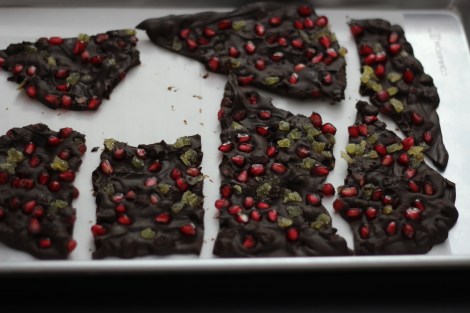
Chocolate barks are a rustic way of presenting the ever-sophisticated chocolate. It is just some nuts or fruits and spices suspended in a big pool of melted chocolate. When cooled, it could be broken into pieces that resemble tree barks. No right or wrong way of doing it, which makes this recipe easy for people working with real chocolate for the first time. This bark, when served as a dessert, will double up as palate-cleanser too because of the fresh fruit and ginger.
This bejeweled confectionery is as much a pleasure to gaze at, as it is to consume. The studded pomegranate arils and candied ginger remind me of Garnets & Citrines.
For the chocolate, use good-quality chocolate bar (couverture chocolate / baking bar) with 60%-70% cacao solids. Do not use chocolate chips unless they are in couverture form.
The best way to melt chocolate is to use a double boiler. If you do not have one, make one using a saucepan and a bowl whose base is as big as the mouth of the saucepan. The base should sit well on the rim of the pan without sinking into the saucepan. Fill a quarter of the saucepan with water, bring it to a boil, reduce the heat to low and let simmer until steaming. Place the bowl on top of it (making sure the base of the bowl does not come in contact with the simmering water below). Add the chopped chocolate to the bowl and keep stirring until the chocolate melts.
You could also melt it in a glass or ceramic bowl in the microwave oven in short bursts of 8 seconds each at defrost mode or power level 3. If so, melt only until half the chocolate is melted. Keep stirring the chocolate after that and the residual heat will melt the rest of the chocolate.
Pomegranate has about 75% water. So, this is not an ideal chocolate for storage. The easiest way to get the arils out: Cut the pomegranate in half lengthwise and tap the rind part so the seeds fall into a large bowl set on the counter.
I did not use sea salt for sprinkling because this is not a super-sweet confectionery like caramel. The dark chocolate gives it a good balance of bitterness between the sweet pomegranate and the slightly-pungent ginger.
For the Chocolate bark:
300 gm / 10 oz. (2 cups) – Dark chocolate Bar (chopped)
2 Tablespoons – Candied Ginger (finely chopped)
1 large pomegranate (or 2 small ones) – fresh Pomegranate arils
1/4 teaspoon (optional, for sprinkling) – Flaky sea salt
Gently dab the pomegranate arils with a clean kitchen towel to remove excess moisture. Line a quarter baking sheet (13” x 9”) with parchment.
Melt the chocolate using a double boiler until about 90% of the chocolate melts. Remove the bowl, wipe the bottom of the bowl dry and stir until all the chocolate is melted. Stir in half the pomegranate arils & candied ginger.
Pour onto the prepared baking sheet to an area of 8” x 10” rectangle. Sprinkle the remaining pomegranate arils & ginger over the chocolate and gently press them in. Sprinkle the sea salt evenly, if using. Refrigerate until completely set about 30 minutes.
Break the chocolate into big barks. This bark can be refrigerated for up to 3 days in the refrigerator (as if it is gonna last that long!), although it is better to consume immediately.
It will form condensation if stored refrigerated because of the wet pomegranate arils. So, wrap the remaining barks in unbleached paper towels and store in a container with the lid slightly open.
Adapted from Fine Cooking magazine
 Cafetude